 Add to Chrome
 Add to Firefox
 Add to Edge
CoMo3R-SLAM: Collaborative Monocular Dense SLAM with Learned 3D Reconstruction Priors for Outdoor Multi-Agent Systems
May 28, 2026
Collaborative dense SLAM is essential for multi-robot teams to achieve scalable and consistent 3D perception across large-scale outdoor environments. Existing systems typically depend on depth sensors, incurring significant payload, power, and calibration costs. Monocular RGB cameras are a lightweight alternative, but collaborative monocular dense SLAM remains difficult due to scale ambiguity, unreliable inter-agent data association, especially in outdoor scenes where low overlap and repetitive structures make traditional feature matching unreliable, motivating robust geometric information. We propose CoMo3R-SLAM, the first collaborative monocular dense RGB SLAM system that leverages robust learned feed-forward 3D reconstruction priors for outdoor multi-agent mapping. Each agent runs a prior-guided front-end for real-time tracking and local dense fusion, while a coordinator performs dense pointmap matching for cross-agent verification, closed-form Sim(3) gauge synchronization, and GPU-accelerated global bundle adjustment with segment-level depth optimization. Requiring neither depth sensors nor parametric intrinsics, our system produces robust cross-agent constraints and globally consistent metric maps from monocular RGB alone. On Tanks and Temples and Waymo sequences, CoMo3R-SLAM achieves the best ATE on three of four Tanks and Temples scenes and competitive Waymo accuracy, matching or exceeding state-of-the-art RGB-D methods while running online at 8 FPS.

StepAudio 2.5 Technical Report
May 22, 2026Unified audio-language modeling has emerged as a prominent trend in modern speech systems, promising to bring the reasoning capabilities of large language models to auditory tasks. However, existing unified foundations often struggle to match the depth of specialized systems across automatic speech recognition (ASR), text-to-speech synthesis (TTS), and realtime spoken interaction. Bridging this gap remains an open challenge. This report presents StepAudio 2.5, a unified audio-language foundation model that matches or exceeds specialized systems across all three capabilities. Rather than treating these tasks as architecturally distinct, we operate on the premise that once text and audio share a multimodal representational space, task specialization becomes a matter of operational regimes: data construction, optimization targets, and decoding constraints. Guided by this insight, we advance the post-training paradigm from standard supervised learning to task-tailored Reinforcement Learning from Human Feedback (RLHF), using it as the primary mechanism to define complex optimization targets. We leverage this RLHF-centric alignment, alongside specialized decoding, to shape a shared backbone into three distinct operational modes. Concretely, the ASR branch advances transcription efficiency via verifiable multi-token decoding; the TTS branch achieves controllable, expressive synthesis through preference-based RLHF and context-rich supervision; and the Realtime branch realizes low-latency, persona-consistent dialogue via generative reward modeling within an RLHF framework. On standard benchmarks, StepAudio 2.5 achieves state-of-the-art results across ASR, TTS, and Realtime, demonstrating that a singular audio-language foundation can successfully internalize the distinct deployment objectives of speech understanding, generation, and live interaction.
HFP-SAM: Hierarchical Frequency Prompted SAM for Efficient Marine Animal Segmentation
Mar 13, 2026Marine Animal Segmentation (MAS) aims at identifying and segmenting marine animals from complex marine environments. Most of previous deep learning-based MAS methods struggle with the long-distance modeling issue. Recently, Segment Anything Model (SAM) has gained popularity in general image segmentation. However, it lacks of perceiving fine-grained details and frequency information. To this end, we propose a novel learning framework, named Hierarchical Frequency Prompted SAM (HFP-SAM) for high-performance MAS. First, we design a Frequency Guided Adapter (FGA) to efficiently inject marine scene information into the frozen SAM backbone through frequency domain prior masks. Additionally, we introduce a Frequency-aware Point Selection (FPS) to generate highlighted regions through frequency analysis. These regions are combined with the coarse predictions of SAM to generate point prompts and integrate into SAM's decoder for fine predictions. Finally, to obtain comprehensive segmentation masks, we introduce a Full-View Mamba (FVM) to efficiently extract spatial and channel contextual information with linear computational complexity. Extensive experiments on four public datasets demonstrate the superior performance of our approach. The source code is publicly available at https://github.com/Drchip61/TIP-HFP-SAM.
DMESR: Dual-view MLLM-based Enhancing Framework for Multimodal Sequential Recommendation
Feb 14, 2026Sequential Recommender Systems (SRS) aim to predict users' next interaction based on their historical behaviors, while still facing the challenge of data sparsity. With the rapid advancement of Multimodal Large Language Models (MLLMs), leveraging their multimodal understanding capabilities to enrich item semantic representation has emerged as an effective enhancement strategy for SRS. However, existing MLLM-enhanced recommendation methods still suffer from two key limitations. First, they struggle to effectively align multimodal representations, leading to suboptimal utilization of semantic information across modalities. Second, they often overly rely on MLLM-generated content while overlooking the fine-grained semantic cues contained in the original textual data of items. To address these issues, we propose a Dual-view MLLM-based Enhancing framework for multimodal Sequential Recommendation (DMESR). For the misalignment issue, we employ a contrastive learning mechanism to align the cross-modal semantic representations generated by MLLMs. For the loss of fine-grained semantics, we introduce a cross-attention fusion module that integrates the coarse-grained semantic knowledge obtained from MLLMs with the fine-grained original textual semantics. Finally, these two fused representations can be seamlessly integrated into the downstream sequential recommendation models. Extensive experiments conducted on three real-world datasets and three popular sequential recommendation architectures demonstrate the superior effectiveness and generalizability of our proposed approach.
Interactive Spatial-Frequency Fusion Mamba for Multi-Modal Image Fusion
Feb 04, 2026Multi-Modal Image Fusion (MMIF) aims to combine images from different modalities to produce fused images, retaining texture details and preserving significant information. Recently, some MMIF methods incorporate frequency domain information to enhance spatial features. However, these methods typically rely on simple serial or parallel spatial-frequency fusion without interaction. In this paper, we propose a novel Interactive Spatial-Frequency Fusion Mamba (ISFM) framework for MMIF. Specifically, we begin with a Modality-Specific Extractor (MSE) to extract features from different modalities. It models long-range dependencies across the image with linear computational complexity. To effectively leverage frequency information, we then propose a Multi-scale Frequency Fusion (MFF). It adaptively integrates low-frequency and high-frequency components across multiple scales, enabling robust representations of frequency features. More importantly, we further propose an Interactive Spatial-Frequency Fusion (ISF). It incorporates frequency features to guide spatial features across modalities, enhancing complementary representations. Extensive experiments are conducted on six MMIF datasets. The experimental results demonstrate that our ISFM can achieve better performances than other state-of-the-art methods. The source code is available at https://github.com/Namn23/ISFM.
Stabilizing Diffusion Posterior Sampling by Noise--Frequency Continuation
Jan 30, 2026Diffusion posterior sampling solves inverse problems by combining a pretrained diffusion prior with measurement-consistency guidance, but it often fails to recover fine details because measurement terms are applied in a manner that is weakly coupled to the diffusion noise level. At high noise, data-consistency gradients computed from inaccurate estimates can be geometrically incongruent with the posterior geometry, inducing early-step drift, spurious high-frequency artifacts, plus sensitivity to schedules and ill-conditioned operators. To address these concerns, we propose a noise--frequency Continuation framework that constructs a continuous family of intermediate posteriors whose likelihood enforces measurement consistency only within a noise-dependent frequency band. This principle is instantiated with a stabilized posterior sampler that combines a diffusion predictor, band-limited likelihood guidance, and a multi-resolution consistency strategy that aggressively commits reliable coarse corrections while conservatively adopting high-frequency details only when they become identifiable. Across super-resolution, inpainting, and deblurring, our method achieves state-of-the-art performance and improves motion deblurring PSNR by up to 5 dB over strong baselines.
Training LLMs with Fault Tolerant HSDP on 100,000 GPUs
Jan 30, 2026Large-scale training systems typically use synchronous training, requiring all GPUs to be healthy simultaneously. In our experience training on O(100K) GPUs, synchronous training results in a low efficiency due to frequent failures and long recovery time. To address this problem, we propose a novel training paradigm, Fault Tolerant Hybrid-Shared Data Parallelism (FT-HSDP). FT-HSDP uses data parallel replicas as units of fault tolerance. When failures occur, only a single data-parallel replica containing the failed GPU or server is taken offline and restarted, while the other replicas continue training. To realize this idea at scale, FT-HSDP incorporates several techniques: 1) We introduce a Fault Tolerant All Reduce (FTAR) protocol for gradient exchange across data parallel replicas. FTAR relies on the CPU to drive the complex control logic for tasks like adding or removing participants dynamically, and relies on GPU to perform data transfer for best performance. 2) We introduce a non-blocking catch-up protocol, allowing a recovering replica to join training with minimal stall. Compared with fully synchronous training at O(100K) GPUs, FT-HSDP can reduce the stall time due to failure recovery from 10 minutes to 3 minutes, increasing effective training time from 44\% to 80\%. We further demonstrate that FT-HSDP's asynchronous recovery does not bring any meaning degradation to the accuracy of the result model.
The Llama 4 Herd: Architecture, Training, Evaluation, and Deployment Notes
Jan 15, 2026This document consolidates publicly reported technical details about Metas Llama 4 model family. It summarizes (i) released variants (Scout and Maverick) and the broader herd context including the previewed Behemoth teacher model, (ii) architectural characteristics beyond a high-level MoE description covering routed/shared-expert structure, early-fusion multimodality, and long-context design elements reported for Scout (iRoPE and length generalization strategies), (iii) training disclosures spanning pre-training, mid-training for long-context extension, and post-training methodology (lightweight SFT, online RL, and lightweight DPO) as described in release materials, (iv) developer-reported benchmark results for both base and instruction-tuned checkpoints, and (v) practical deployment constraints observed across major serving environments, including provider-specific context limits and quantization packaging. The manuscript also summarizes licensing obligations relevant to redistribution and derivative naming, and reviews publicly described safeguards and evaluation practices. The goal is to provide a compact technical reference for researchers and practitioners who need precise, source-backed facts about Llama 4.
RSATalker: Realistic Socially-Aware Talking Head Generation for Multi-Turn Conversation
Jan 15, 2026Talking head generation is increasingly important in virtual reality (VR), especially for social scenarios involving multi-turn conversation. Existing approaches face notable limitations: mesh-based 3D methods can model dual-person dialogue but lack realistic textures, while large-model-based 2D methods produce natural appearances but incur prohibitive computational costs. Recently, 3D Gaussian Splatting (3DGS) based methods achieve efficient and realistic rendering but remain speaker-only and ignore social relationships. We introduce RSATalker, the first framework that leverages 3DGS for realistic and socially-aware talking head generation with support for multi-turn conversation. Our method first drives mesh-based 3D facial motion from speech, then binds 3D Gaussians to mesh facets to render high-fidelity 2D avatar videos. To capture interpersonal dynamics, we propose a socially-aware module that encodes social relationships, including blood and non-blood as well as equal and unequal, into high-level embeddings through a learnable query mechanism. We design a three-stage training paradigm and construct the RSATalker dataset with speech-mesh-image triplets annotated with social relationships. Extensive experiments demonstrate that RSATalker achieves state-of-the-art performance in both realism and social awareness. The code and dataset will be released.
TCDE: Topic-Centric Dual Expansion of Queries and Documents with Large Language Models for Information Retrieval
Dec 19, 2025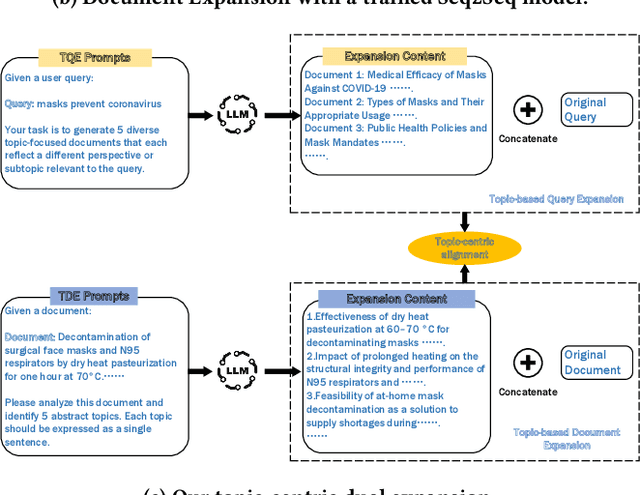
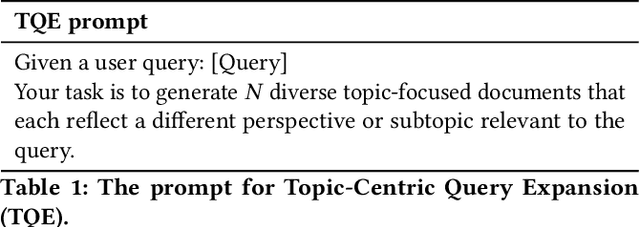
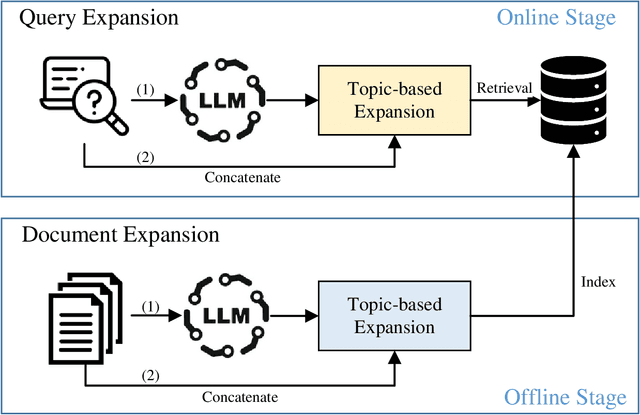
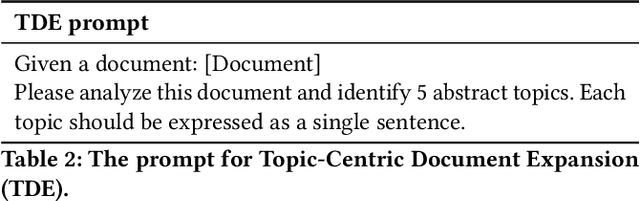
Query Expansion (QE) enriches queries and Document Expansion (DE) enriches documents, and these two techniques are often applied separately. However, such separate application may lead to semantic misalignment between the expanded queries (or documents) and their relevant documents (or queries). To address this serious issue, we propose TCDE, a dual expansion strategy that leverages large language models (LLMs) for topic-centric enrichment on both queries and documents. In TCDE, we design two distinct prompt templates for processing each query and document. On the query side, an LLM is guided to identify distinct sub-topics within each query and generate a focused pseudo-document for each sub-topic. On the document side, an LLM is guided to distill each document into a set of core topic sentences. The resulting outputs are used to expand the original query and document. This topic-centric dual expansion process establishes semantic bridges between queries and their relevant documents, enabling better alignment for downstream retrieval models. Experiments on two challenging benchmarks, TREC Deep Learning and BEIR, demonstrate that TCDE achieves substantial improvements over strong state-of-the-art expansion baselines. In particular, on dense retrieval tasks, it outperforms several state-of-the-art methods, with a relative improvement of 2.8\% in NDCG@10 on the SciFact dataset. Experimental results validate the effectiveness of our topic-centric and dual expansion strategy.